
Personal Protective Equipment – PPE
The Chief Health Officer and the State Health Emergency Coordination Centre, in considering the risk of community and setting-specific transmission within Bundaberg is now to be within the “high” risk category.
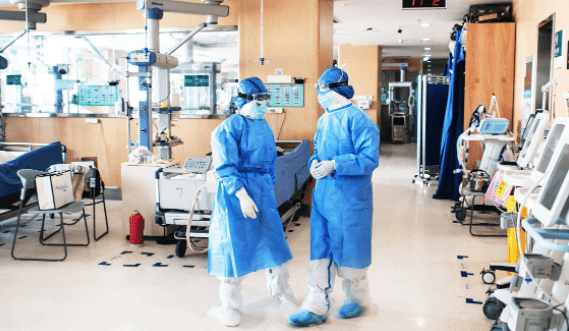
These precautions are intended to limit the further spread of this variant in the community and allow an assessment of risk of any further exposure in the community. In addition to standard precautions +/- transmission-based precautions if indicated for another reason, the following recommended Personal Protective Equipment (PPE) escalation in healthcare settings has been advised.
Effective immediately the following escalation of PPE will be implemented within the FSPH.
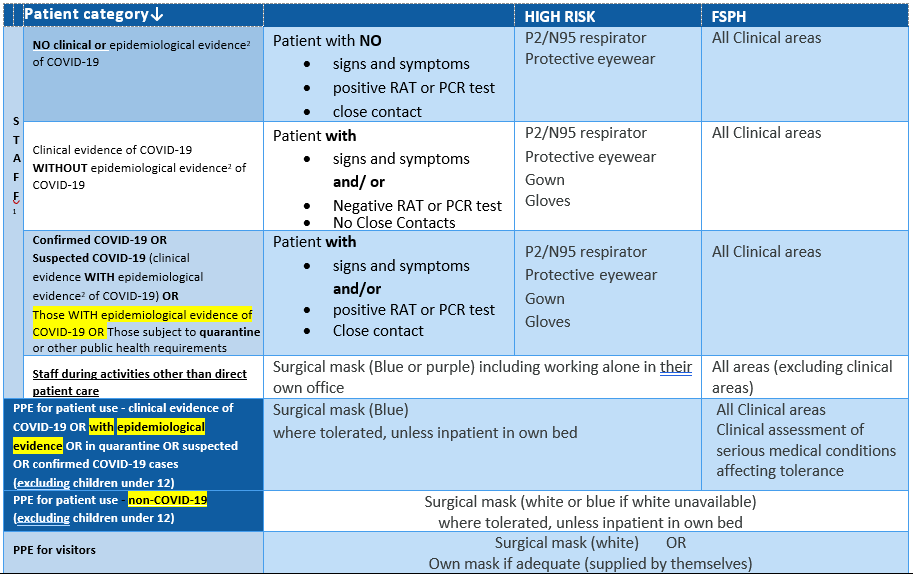
To assist the reduction in cross contamination please reduce non-essential travel through or into clinical areas. If staff are not routinely rostered to a clinical area but are required to provide services then the above PPE will be used (i.e., Hotel Services, Medical Records).
The Nurse Unit Manager or delegate will assist and monitor the use of PPE in the clinical areas.
Surgical face masks are now mandatory for all staff- including Visiting Medical officers, company representatives and contract maintenance personnel.
Footnotes
1Healthcare staff who reside in an area that is designated a different risk level to the healthcare facility they work are to comply with their workplace facility risk PPE requirements.
2Epidemiological evidence includes, in the last 14 days: close contact with a confirmed case of COVID-19; international travel with the exception of green zone countries; workers supporting designated COVID-19 quarantine and isolation services; international border staff; international air and maritime crew; people who have been in a setting where there is a COVID-19 case e.g. in close contact category at a QH exposure location, in casual contact category at a QH exposure location pending a negative COVID-19 test result, QH interstate exposure venues; people who have been in areas with recent local transmission of SARS-Cov-2
e.g. QH hotspots. (those who are fully vaccinated and have been in a hotspot should be managed as per those with epidemiological risk pending a negative test result day 5 after leaving the hotspot) (Risk-assess health, aged and residential care workers)